Interpretative Key 1: Bible Time Accounting Is Different than Modern Methods
[Credit: me. Remember: I’m not saying I invented this, but rather that I developed this idea independently (as far as I can remember) and don’t know whether others have done so before me.]
The Bible writers did not measure time the same way we do. We generally think of years lived or years ruled in terms of complete 12-month periods, starting from the day of birth or of a king being crowned. In the Bible, however, length of time is measured according to the years in which events occur.
How this works:
- The year someone is born or begins reigning is year zero. However, the Bible doesn’t use the word “zero” to describe that year. Instead, it simply indicates that in that year, someone was born or “began to reign” or, in the case of Adam, was created.
- A person has lived or reigned for one year after they cross their first New Year line. It doesn’t matter what dates they start and stop on or whether there are more or less than 12 months between those two dates. Every additional year of life or reigning starts with each New Year.
- If the entirety of a life or reign occurs within a single calendar year, then the length of it will be given in days or months.
- In a royal transition, the calendar year in which the first king dies (or establishes a co-reign) is counted as a year of their reign, even if they didn’t live (or rule solo) all year. That calendar year is also “year 0” for the new king (the year the new king “began to reign”).
For example, Adam was created in what we today would call the “first year” of creation. However, the Bible would call that first year “the year Adam was created.” Numerically, we would set that year to “0.” Then the next calendar year would be year 1 and would be Adam’s first year.
Adam was 130 when Seth was born, so that would be Adam’s one hundred and thirtieth year in the numerical year 130. That year would be “the year Seth was born,” but it wouldn’t be Seth’s “first year.” Instead, the following year, 131, would be the 131st year of Adam and the 1st year of Seth.
This makes chronology very easy to track in the Bible, because we don’t have to worry about what months things happen in, and therefore we don’t ever get confused about what calendar year events occur in, because the calendar year is paramount in counting lifespans and reigns. It also makes lifespans and reigns very easy to stack on top of each other numerically (you just add the numbers together).
This is also why birthdays are rarely mentioned in the Bible: the Jews did not care about birthdays once a person crossed their first New Year line. At that point, a person’s lifespan would be counted according to how many calendar years they lived through.
Evidence for this system is not just the way lifespans are given throughout the Bible, but also the fact that it’s the only way to explain the length of reigns and the connection points between Northern and Southern kings in 1 and 2 Kings. It also explains why David is said to have reigned in Hebron seven years and six months in 2 Samuel 2:11, 2 Samuel 5:5, and 1 Chronicles 3:4, but only seven years in 1 Kings 2:11 and 1 Chronicles 29:27: the seven years and six months had to do with an absolute length of time, while David crossed the New Year line only seven times in Hebron and so could also be said to have reigned “seven years” there.
This system is not used for, say, counting the number of children a person has. The boy who opens the womb is still the “first” child. But when it comes to chronology, it is akin to a building having a ground floor, and then the floor above the ground floor being the “first floor.”
Calculations
0: God creates, structures, and populates the heavens and earth
Exodus 20:11 and 31:17 confirm that the creation week lasted six literal days, just as Genesis 1 proclaims. Models that deny this are generally built around an attempt to accommodate naturalistic scientific paradigms that assume there are no such thing as miracles. As the Bible clearly demands the existence of a God who performs miracles, such attempts are unfaithful to the intended meaning of the text (see The “Problem” of Biblical Literalism).
Until a model is provided that makes better sense of how the Bible is intended to be interpreted than the traditional creationist view, we must accept that the heavens and the earth were created, structured, and populated in the first six literal days of the existence of the world.
The Cosmology of the Heavens
Genesis 1:1 says, “In the beginning God created the heavens and the earth.” The Hebrew word šāmayim for “heavens” is a duale tantum, a noun that always appears in a plural form indicating two of something. While most translators assume that it is essentially a plurale tantum (i.e., a noun that always appears as a plural), with the dual form being insignificant or archaic, we should consider that God made it dual for a reason.
If we do, then this helps us make sense of the exact timeline in play in the opening verse of the Bible. Notably, what we nowadays typically think of as “Heaven,” i.e., the physically inaccessible realm where God lives, is referred to in the Old Testament as “the heavenly heavens,” sometimes translated as “the heaven of heavens” or “the highest heavens.” There is no evidence I can find for this physically inaccessible part of the heavens being multi-part; rather, there is just one upper-case “Heaven.”
Thus, the “heavens” of Genesis 1:1 must refer to the dual system of the “heavenly heavens” and “earthly heavens,” the latter of which God created on the second day of the creation week. Therefore, Genesis 1:1 must be a summary statement of the entire creation week (or at least up through Day 3), not just of the creation of the heavenly heavens and the unformed earth.
As mentioned in The Seven-Day Metanarrative, there is a pattern of the Bible laying out a story with a short summary of the ending, then revisiting the later part of that story to provide more detail, then continuing through and beyond the previous ending. That is exactly what is happening here, with a high-level summary of the creation of the world in Genesis 1:1 being followed by a revisiting of the details of the creation of the earth, then continuing through to the Sabbath day.
We can see in Genesis 1:6-8 that during the forming, shaping, and filling of the earth, God created on Day 2 a firmament to divide waters below from waters above, then called the firmament “the heavens,” the same Hebrew word šāmayim. These earthly heavens are themselves dual, with the earth’s atmosphere being the first heaven and outer space being the second heaven.
The clouds are the waters that separate the first heaven from the second heaven (which is why men climb mountains in the Bible to be more closely connected with God’s presence), and there is also water in outer space, and under God’s throne there is sapphire, the water that separates outer space from the highest heaven (Exodus 24:10; Psalm 148:4). This highest heaven (what we call “Heaven”) would be the third heaven (2 Corinthians 12:2).
The reason our visible heavens are dual is to provide a perceptible symbol for all mankind of the duality between our earthly heavens and the heavenly heavens (see Isaiah 55:9 for the importance of distinguishing between above and below). Thus, when we see the Hebrew word šāmayim in the Old Testament, it could be referring to either the internally dual earthly heavens or the overall duality of “earthly heavens and heavenly heavens,” depending on context.
We see this three-level system (heaven of heavens, dual earthly heavens, earth) explicitly called out several times in Scripture, especially in terms of distinguishing the earthly heavens from the heavenly heavens: for example, 1 Kings 8:27, 2 Chronicles 2:6, 2 Chronicles 6:18, Nehemiah 9:6, Psalm 68:8/33, Psalm 148:4. Moreover, God’s ownership of everything encompasses the heavens and the earth (1 Chronicles 29:11), which more specifically is the earth, heavens, and heavenly heavens (Deuteronomy 10:14).
Based on which duality “the heavens” refers to, the “host of the heavens” could mean stars and sun and moon (which Israel was commanded not to worship in Exodus 20:4 but still did in 2 Kings 23:5, Jeremiah 8:1-2, and Acts 7:43), but it could also mean the angelic host of the heavenly heavens (1 Kings 22:19-23, 2 Chronicles 18:18-22). This angelic host is also called the “army of the heavens” (Daniel 4:35).
Now, in New Testament Greek, the word for heaven, ouranos, can be either singular or plural, which leads to some interesting nuances of how it is used. First, in the common phrase “kingdom of heaven” (first appearing in Matthew 3:2), “heaven” is plural, suggesting that God’s presence and power extends through all three heavens, not solely the highest heaven. Similarly, Matthew 5:16 and 6:9 suggest that God the Father is “in the heavens” (plural).
However, in many cases where the highest heaven (“Heaven”) is distinguished from the realm of the earth, “heaven” is singular, such as in Matthew 5:18, 5:34-35 (where Heaven is called “God’s throne”), 6:10 (which suggests that God’s will is done automatically in Heaven but not automatically on the earth), and 6:19-20 (which suggests that our eternal treasure is in Heaven), among others.
Matthew 24:35 symbolizes the end of the Old Covenant as the passing away of Heaven (singular) and earth, while Revelation 21:1 likewise describes the New Covenant as the coming of a new Heaven (singular) and a new earth. “Heaven and earth” are the two realms of which God the Father is Lord (Matthew 11:25), but He gave Jesus authority over both of them after His resurrection (Matthew 28:18).
Sometimes the use of singular vs. plural can be fluid based on nuance, such as how Matthew 16:19 indicates that what Peter binds on earth will be bound in the heavens (plural), whereas Matthew 18:18 indicates that what the disciples bind on earth will be bound in Heaven (singular). At other times the singular word “heaven” can refer to the first heaven, i.e., the earth’s atmosphere, such as in Matthew 8:20 and 13:32 (where it is translated as “air”).
In fact, this leads to more clarity around Matthew 16:1-4, where the Pharisees and Sadducees seek a sign from Heaven (i.e., the third heaven), but Jesus points out that they can read the signs of the first heaven (“sky”) just fine, so why can’t they read the equally obvious signs of the third heaven? His implied answer: they are earthly (worldly) people, not heavenly people.
Counting Days in the Creation Week
Based on how time accounting works in the Bible, per Interpretative Key 1, we would expect the beginning of creation to happen on “the day the heavens and the earth were created,” i.e., Day 0, not “on the first day,” i.e., Day 1. We know Genesis 1:1 is a summary of the creation week, and then light was created on Day 1, per Genesis 1:5. So what happened on Day 0?
Well, per James B. Jordan (Biblical Chronology 9-10: The Sequence of Events in the Creation Week, Part 1):
“The earth as it was made was good, of course, but not yet developed. It lacked structure, was empty, and was dark. Nothing like this is said of heaven. Indeed, it is clear from the rest of the Bible that heaven was made structured, full, and bright from the beginning. The angelic host does not multiply, and so new angels do not appear in the process of time. Humanity was created as a race that matures into a host, while the angels were created as a host from the beginning.
The earth matures in a way that heaven does not. Heaven is thus the model or paradigm for the earth. The earth is to grow more and more heaven-like.”
Based on this understanding, we can infer that the highest heaven and the angels that dwell within it were created fully formed on Day 0.
But when was the earth created? Interestingly, starting with Genesis 1:5, we see that God records time with the evening first, then morning (bear in mind that God must have dictated Genesis 1 to Adam and Eve, since they didn’t even exist until Day 6, so the language in use is entirely of God’s own choosing). This is contrary to how humans record time, as we consider the daytime the first half of the day, since we begin working in the day, then rest at night. In fact, in line with this, Jewish timekeeping started at daybreak, not in the middle of the night like ours does (see, for example, Acts 2:15 – I personally think this method makes a lot more sense than starting the day at midnight).
This means God’s time was different than our time when the world was created. Here is my proposed explanation for this:
- In the original Heaven, before there was an earth, there was no night (according to Revelation 22:25, this situation was restored in 70 AD, when the New Covenant came into full force – the timing of the New Heaven and the New Earth will be discussed more in The Millennium and the Future). This lack of night has to do with God being like a light that never shuts off (John 9:4-5; Revelation 22:23).
- Therefore, Day 0 only encompassed a morning time.
- When the earth was created in its dark, unstructured, underwater form (Genesis 1:2), that initiated the following day, which would be “Day 1.” However, because the previous day was only a morning time, God’s Day 1 began in the evening and ended in the morning.
- God’s various creative activities in the creation week occurred in the morning times, when the light of the Spirit was shining on the earth.
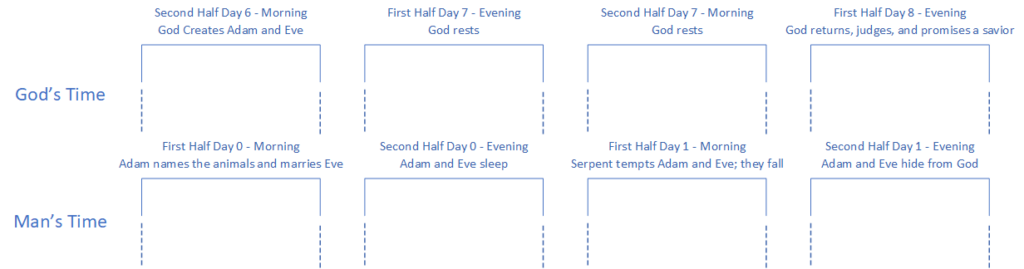
- As soon as Adam was created in the morning of God’s Day 6, “man’s time” would have begun, with the first half of Adam’s “Day 0” being the morning (second half) of God’s Day 6, while the second half of Adam’s “Day 0” would have been the evening (first half) of God’s Day 7.
There were thus two kinds of time that existed during the Old Covenant: God’s time and man’s time. God’s time was lunar and priestly, while man’s time was solar and kingly (see The Seven-Day Metanarrative for more information), leading to the use of a lunisolar calendar in the Bible. In the New Covenant, with Jesus as both High Priest and King, we only have one type of time, which is why we have since transitioned to a purely solar calendar.
Note that God having a “heavenly” time system and man having an “earthly” time system accords with Psalm 115:16, which indicates that during the Old Covenant, God owned the heavens, while man owned the earth. The disconnect is, of course, resolved now that all authority in Heaven and on earth has been given to the God-man Jesus Christ, as previously mentioned.
0: Adam and Eve fall
The creation days being literal days also explains God’s absence at the time of Adam and Eve’s fall: it occurred on the seventh day, while He was resting (Genesis 2:3).
God would have left to rest at the end of the morning of His Day 6 (second half of God’s Day 6, first half of man’s Day 0). Adam and Eve would have slept through the following nighttime (first half of God’s Day 7, second half of man’s Day 0). The serpent would then have tempted them in the following daytime (second half of God’s Day 7, first half of man’s Day 1).
Thus, with the morning of God’s Day 6 and the evening of God’s Day 7 being “the day Adam was created” (man’s Day 0), Adam fell on his “first day” (Day 1) of existence. God would then have returned right at the beginning of His Day 8, in the “cool of the day” (Genesis 3:8), when night was falling on Adam’s Day 1.
Here’s a visual illustration of Adam and Eve’s first few days:
The Timing of Satan’s Fall
A final detail to nail down in the creation week is: when did Satan fall?
Well, as mentioned, God gave the earth to man in the Old Covenant. Unlike the angels, men and women are made in the image of God, and the angels were merely guardians and stewards of mankind during our collective childhood, with us destined to be God’s heirs (Galatians 4:1-2). That’s why the Law was given by the direction of angels (Acts 7:53).
Moreover, Paul promised the first-century Christians in 1 Corinthians 6:3 that they would judge angels. Jesus also did not die for angels, so they are not eligible for salvation (Hebrews 2:16). While these details would not have been obvious during the creation week to the angels (1 Peter 1:12 indicates that angels did not have special knowledge of the mysteries of the gospel beforehand), it would have been clear after the creation of Adam and Eve that angels would one day play second fiddle to us.
Satan must have therefore become jealous of man’s special role relative to angels and led a rebellion in Heaven. Now, Revelation 12:3-4 shows an image of Satan as a dragon and says that “his tail drew a third of the stars of heaven and threw them to the earth.” This use of “star” imagery suggests that Satan led a third of the angels of heaven into demonic rebellion during the nighttime of God’s Day 7 (first half of God’s Day 7, second half of man’s Day 0), which also accords with the fact that God was resting at that time.
This would put Satan’s fall exactly halfway between man’s creation and man’s fall, and it indicates that the nighttime of God’s Day 7 was not merely blank space, but an important part of the creation narrative.
Commentary
The exact timing of the sequence of events in the creation week sets up three patterns we see in the rest of the Bible:
- Man fails on a seventh of something.
- God saves on an eighth of something, especially at the beginning of the eighth day/year/etc. It was at that point God promised a savior (Genesis 3:15) and covered Adam and Eve with bloody animal skins to foreshadow Jesus’ sacrifice (Genesis 3:21). This is why circumcision was done on the eighth day (Leviticus 12:3).
- Because the daytime of Day 7 was part of Adam’s “first day,” human covenant leaders fail immediately after the establishment of a covenantal system.
Leave a Reply