Interpretative Key 1: Bible Time Accounting Is Different than Modern Methods
[Credit: me. Remember: I’m not saying I invented this, but rather that I developed this idea independently (as far as I can remember) and don’t know whether others have done so before me.]
The Bible writers did not measure time the same way we do. We generally think of years lived or years ruled in terms of complete 12-month periods, starting from the day of birth or of a king being crowned. In the Bible, however, length of time is measured according to the years in which events occur.
How this works:
- The year someone is born or begins reigning is year zero. However, the Bible doesn’t use the word “zero” to describe that year. Instead, it simply indicates that in that year, someone was born or “began to reign” or, in the case of Adam, was created.
- A person has lived or reigned for one year after they cross their first New Year line. It doesn’t matter what dates they start and stop on or whether there are more or less than 12 months between those two dates. Every additional year of life or reigning starts with each New Year.
- If the entirety of a life or reign occurs within a single calendar year, then the length of it will be given in days or months.
- In a royal transition, the calendar year in which the first king dies (or establishes a co-reign) is counted as a year of their reign, even if they didn’t live (or rule solo) all year. That calendar year is also “year 0” for the new king (the year the new king “began to reign”).
For example, Adam was created in what we today would call the “first year” of creation. However, the Bible would call that first year “the year Adam was created.” Numerically, we would set that year to “0.” Then the next calendar year would be year 1 and would be Adam’s first year.
Adam was 130 when Seth was born, so that would be Adam’s one hundred and thirtieth year in the numerical year 130. That year would be “the year Seth was born,” but it wouldn’t be Seth’s “first year.” Instead, the following year, 131, would be the 131st year of Adam and the 1st year of Seth.
This makes chronology very easy to track in the Bible, because we don’t have to worry about what months things happen in, and therefore we don’t ever get confused about what calendar year events occur in, because the calendar year is paramount in counting lifespans and reigns. It also makes lifespans and reigns very easy to stack on top of each other numerically (you just add the numbers together).
This is also why birthdays are rarely mentioned in the Bible: the Jews did not care about birthdays once a person crossed their first New Year line. At that point, a person’s lifespan would be counted according to how many calendar years they lived through.
Evidence for this system is not just the way lifespans are given throughout the Bible, but also the fact that it’s the only way to explain the length of reigns and the connection points between Northern and Southern kings in 1 and 2 Kings. It also explains why David is said to have reigned in Hebron seven years and six months in 2 Samuel 2:11, 2 Samuel 5:5, and 1 Chronicles 3:4, but only seven years in 1 Kings 2:11 and 1 Chronicles 29:27: the seven years and six months had to do with an absolute length of time, while David crossed the New Year line only seven times in Hebron and so could also be said to have reigned “seven years” there.
This system is not used for, say, counting the number of children a person has. The boy who opens the womb is still the “first” child. But when it comes to chronology, it is akin to a building having a ground floor, and then the floor above the ground floor being the “first floor.”
Calculations
0: God creates, structures, and populates the heavens and earth
0: Adam and Eve fall
Exodus 20:11 and 31:17 suggest that the creation week lasted seven literal days. Models that deny this are generally built around an attempt to accommodate naturalistic scientific paradigms that assume there are no such thing as miracles. As the Bible clearly demands the existence of a God who performs miracles, such attempts are unfaithful to the intended meaning of the text (see The “Problem” of Biblical Literalism).
Until a model is provided that makes better sense of how the Bible is intended to be interpreted than the traditional creationist view, we find that assuming the creation days were literal days explains God’s absence at the time of Adam and Eve’s fall: it occurred on the seventh day, and He was resting (Genesis 2:3).
Given this understanding, we can make sense of the creation week. When Genesis 1:1 says, “In the beginning God created the heavens and the earth,” that is happening at the beginning of what we today would consider the “first day.” However, the Hebrews would count it as “Day 0” and call it “the day in which God created the heavens and the earth.”
Note that humans consider the daytime the first half of the day, since we begin working in the day and rest at night. In fact, Jewish timekeeping started at daybreak, not in the middle of the night like ours does (see, for example, Acts 2:15 – I personally think this method makes a lot more sense than starting the day at midnight). However, in Genesis 1:5, we see that starting with Day 1, God called the nighttime the first half of the day (“there was evening and there was morning, Day 1”). This means the absolute length of Day 0 was only half a day, and the evening that immediately followed was part of Day 1 (this makes sense when you consider that people can be born at any point during a calendar year, and thus their “year 0” is rarely a full year).
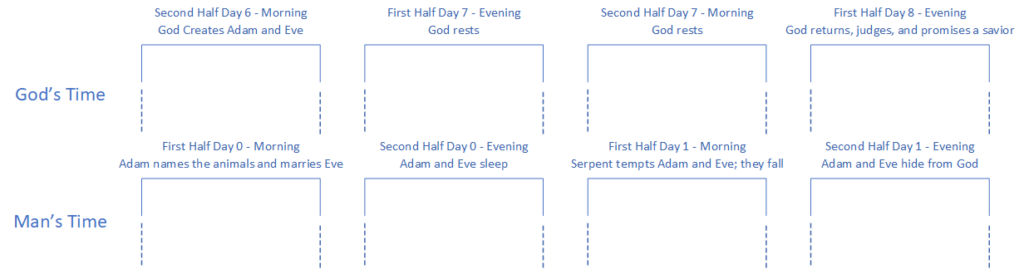
Adam would have been created in the daytime (second half) of God’s Day 6, so Adam’s timekeeping would have begun on the second half of God’s Day 6 at daybreak, which would be the beginning of humanity’s “Day 0.” God would have left to rest, and Adam and Eve would have slept through the following nighttime (second half of man’s Day 0, first half of God’s Day 7). The Serpent would then have tempted them in the following daytime (first half of man’s Day 1, second half of God’s Day 7).
Thus, as Adam was created on God’s Day 6, which the Bible would call “the day Adam was created,” Adam fell on his “first day” of existence. God would have returned right at the beginning of His Day 8, in the “cool of the day” (Genesis 3:8), when night was falling on Adam’s Day 1.
Here’s a visual illustration of Adam and Eve’s first few days:
Commentary
The exact timing of this sequence of events sets up three patterns we see in the rest of the Bible:
- Man fails on a seventh of something (in this case, a day).
- God saves on an eighth of something (in this case, a day), especially at the beginning of the eighth day/year/etc. It was at that point God promised a savior (Genesis 3:15) and covered Adam and Eve with bloody animal skins to foreshadow Jesus’ sacrifice (Genesis 3:21). This is why circumcision was done on the eighth day (Leviticus 12:3).
- Because the daytime of Day 7 was Adam’s “first day,” human covenant leaders fail immediately after the establishment of a covenantal system.
Leave a Reply